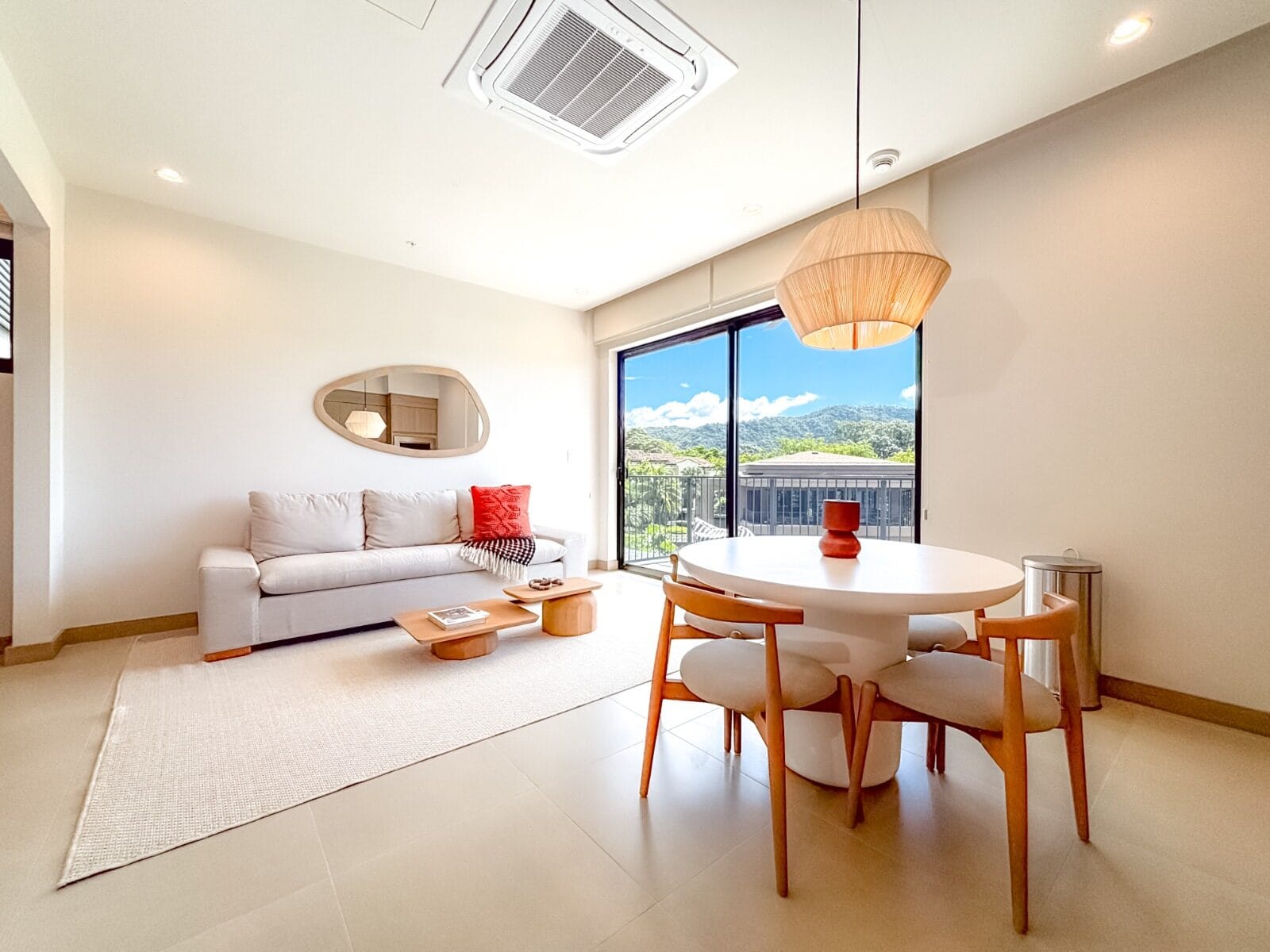
Photo: furnished living area at Na Umi N511. The hypothetical calculation below does not describe this property’s rental performance.
Playas del Coco condo buyer guide
A condo can be a vacation home and a rental property—but those two uses share the same calendar and the same bills. Before buying in Playas del Coco, compare what remains after expenses, not just an attractive nightly rate.
A sensible purchase should fit your budget even when bookings are weaker than expected. This guide shows how to build a property-specific rental worksheet, check the evidence behind a forecast, and compare personal-use plans with income goals.
1. Define how you will use the condo
Write down the nights you want for yourself before estimating rental income. A month reserved for your family cannot also be counted as a month of guest revenue. The timing matters: owner stays during the property’s strongest booking periods can have a larger effect than the same number of nights in quieter periods.
- Mostly personal use: decide how much rental income would help with costs, without making the purchase depend on it.
- Mixed use: build a realistic owner calendar and a guest calendar together.
- Mostly rental use: prioritize the specific unit’s operating record, guest suitability, rental permission and management arrangements.
Be specific about stairs, parking, bedroom configuration, air conditioning, internet, laundry and access. A property that suits you may not suit every guest—and a community’s reputation is not a substitute for evaluating the unit.
2. Separate asking rates, booked rates and net receipts
An online listing shows what an owner is asking for selected dates. It does not reveal discounts, empty nights, refunds, cancellations or all fees. Ask for monthly booking records and owner statements, and reconcile them with actual payouts where available.
Gross accommodation revenue = paid guest nights × average accommodation revenue per paid night. Keep this figure consistent: exclude separately collected taxes and avoid treating guest-paid cleaning charges as profit while omitting the corresponding cleaning expense.
Calculate occupancy with an explicit denominator. For example, 150 paid nights out of 300 nights offered for rent is 50% availability-based occupancy, but only about 41% of a 365-day year. Neither figure is useful without knowing which dates were blocked for owner use, maintenance or other reasons.
3. Build a complete expense worksheet
- Booking and management: platform charges, payment processing, management commission, booking administration and any fixed service fees. Confirm the contractual fee base and avoid double-counting bundled services.
- Guest turnover: cleaning, laundry, consumables and any amount not recovered from guests.
- Ownership: HOA charges, insurance, property taxes, utilities and internet, including costs that continue during vacant periods.
- Care and replacement: routine repairs, air-conditioning service, appliances, linens, furniture and a reserve for larger replacements.
- Property-specific extras: assessments, access charges or other obligations shown in the actual documents.
Use the Coco condo ownership-cost guide for the expense categories and the Pacifico HOA guide for questions about community charges. Obtain current figures for the exact unit.
4. Run the numbers: an illustrative example
This is a made-up teaching example, not a Playas del Coco market average, a quote, or a forecast for a listed property. All figures are USD. The expense amounts and fee structure below are assumptions chosen to demonstrate the calculation.
| Assumption or calculation | Annual amount |
|---|---|
| 150 paid nights × $140 average accommodation revenue | $21,000 |
| Combined booking and management costs: assumed 25% of accommodation revenue | −$5,250 |
| HOA, utilities, insurance, property tax and routine care: assumed combined budget | −$9,000 |
| Owner-funded replacement reserve | −$1,500 |
| Illustrative cash remaining before debt service and income taxes | $5,250 |
This simplified example assumes guest cleaning charges exactly cover turnover costs and there are no additional owner-paid charges beyond the amounts shown. Real worksheets must add any shortfall or other expense. The $5,250 is not a guaranteed return and is not the same as accounting profit.
At an assumed $280,000 total acquisition and setup cost, that remaining cash would be about 1.9% before financing and income taxes. Use the full cost—including closing, furnishings and initial work—not only the purchase price. This example says nothing about future appreciation or resale proceeds.
5. Stress-test the quiet periods
Using the same hypothetical $140 rate, 25% variable charges and $10,500 combined annual fixed-cost/reserve allowance:
- 100 paid nights: $14,000 gross revenue leaves $0 after those assumed costs.
- 150 paid nights: $21,000 gross leaves $5,250.
- 180 paid nights: $25,200 gross leaves $8,400.
The simplified break-even point is 100 paid nights: $10,500 ÷ ($140 × 75%). It rises if rates fall, expenses increase or financing payments must be covered. In reality, some utilities and maintenance also change with occupancy; a monthly model should reflect that.
Ask whether you can comfortably carry the condo through the weaker case. Include an unexpected repair and longer vacancy in the stress test rather than relying on the most optimistic calendar.
6. Request evidence before relying on a rental projection
- Monthly rental statements and booking records covering at least a full seasonal cycle where available.
- Paid nights, rates, discounts, owner blocks, cancellations and refunds—not only gross annual revenue.
- Current HOA documents, rental rules, budgets, assessments and relevant meeting records.
- A written management proposal showing services, exclusions, fee bases and reporting.
- Actual utilities, insurance quotes, maintenance history and a furniture/appliance inventory.
- Confirmation of which booking accounts, reviews, future reservations and service agreements can transfer, if any.
A new unit without operating history needs a clearly labeled projection. Comparable properties can help, but different views, stairs, bedrooms, amenities, reviews and management can change the result. Do not present another condo’s revenue as this condo’s history.
Have independent Costa Rican legal and tax professionals confirm the proposed rental use, applicable registrations and tax obligations for your circumstances. Rental rules and tax treatment should be checked for the actual ownership and operating arrangement, not assumed from a listing description.
7. Compare the property, not just the community name
Use the same worksheet for every shortlist candidate. The cheapest HOA is not automatically the best investment, and premium amenities do not automatically justify a higher acquisition price. Compare net cash, capital required, personal enjoyment and the effort of ownership together.
Our Las Palmas versus Pacifico guide helps with community fit. The property-management guide helps you compare operating support. For financing, review the foreign-buyer financing guide and add actual debt payments to your cash-flow model.
Questions buyers often ask
Can rental income cover all the costs?
It may, but that cannot be assumed. The answer depends on the purchase cost, paid nights, rates, fees, personal use and financing. Ask for a property-specific calculation and a downside case.
Does a full-looking booking calendar prove occupancy?
No. Blocked dates can reflect owner stays, maintenance or unavailable inventory rather than paid reservations. Request booking and payout records.
Is gross rental yield enough to compare two condos?
No. Gross revenue divided by price ignores operating expenses, setup costs, financing and taxes. Compare a consistently defined net figure, and state what remains excluded.
Build a shortlist around your ownership plan
Tell Chris your budget, preferred bedroom count and how much time you plan to use the condo yourself. He can help compare current options and identify which property records to request before you rely on a rental projection.